
Dionex UltiMate™ 3000 UHPLC
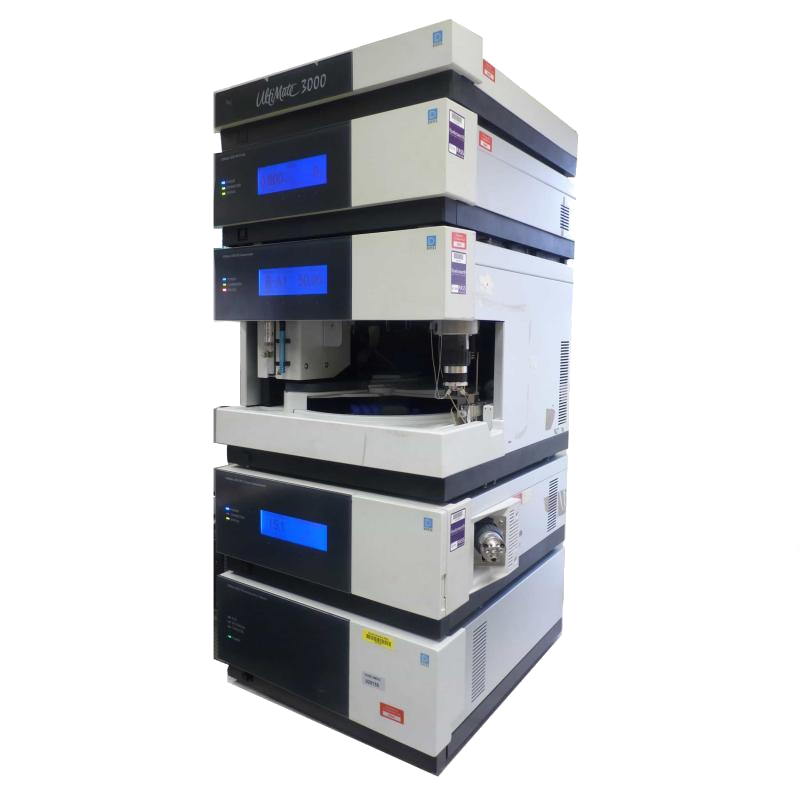
| Thermo Fisher Scientific UltiMate™ 3000 | |
|---|---|
| Location: | Lab. 2.39 Building 8 |
| Manager: | Rodrigo Borges |
| Operator: | Rodrigo Borges |
| Analytical Principle | Chromatography |
| Manufacturer: | Thermo Fisher Scientific |
| Model: | Dionex UltiMate™ 3000 |
| Type: | Liquid Chromatography |
| Detectors: | DAD, FLD, RID, MS/MS |
| Website: | Thermo Fisher Scientific |
A Ultra-High-Performance Liquid Chromatography (UHPLC) system designed for the separation, identification, and quantification of compounds present in simple or complex samples. The system operates by passing a liquid sample through a chromatographic column, where the different components of the sample interact with the stationary phase and are separated based on their chemical properties. UHPLC is widely used in research laboratories, the pharmaceutical industry, analytical chemistry, and other fields requiring fast and accurate analysis of chemical compounds. It allows the use of different chromatographic columns suitable for various types of analyses, including the separation of proteins, peptides, nucleic acids, metabolites, and other chemical compounds. The system offers high sensitivity and the ability to detect compounds at very low concentrations, making it a valuable tool for the analysis of complex samples.
Diode Array Detector (DAD)
The Diode Array Detector (DAD) provides compound detection and quantification through UV-Vis spectroscopy, recording the full absorption spectrum of each analyte. This spectral information enables compound identification through characteristic absorption profiles and quantitative analysis by monitoring signal intensity at the analyte-specific maximum absorption wavelength.
Fluorescence (FLD)
The Fluorescence Detector (FLD) provides highly sensitive detection and quantification of fluorescent compounds, which emit light after excitation by an external radiation source. Due to its exceptional sensitivity and selectivity, the FLD enables the detection of analytes at trace concentration levels. It is widely applied in the analysis of biomolecules, including proteins, peptides, and nucleic acids, as well as in environmental and pharmaceutical applications.
Refraction Index Detector (RID)
The Refractive Index Detector (RID) enables the detection and quantification of compounds based on variations in the refractive index of the mobile phase. It is widely used for the analysis of polymers, carbohydrates, and other compounds that show significant refractive index differences and generally lack chromophoric or fluorescent properties required for detection by other detector technologies.
Mass Detector (MS/MS)
The triple quadrupole mass spectrometer (MS/MS) equipped with an Electrospray Ionization (ESI) source enables the detection and quantification of compounds based on their mass-to-charge ratio (m/z). The MS/MS system provides exceptional sensitivity and selectivity, allowing the detection and quantification of analytes at trace concentration levels. It is widely used for the analysis of biomolecules, including proteins, peptides, and nucleic acids, as well as in environmental, pharmaceutical, and metabolomics applications.
Implemented Methods:
| Method | Developer |
|---|---|
| Photosynthetic Pigments | Rodrigo Borges (Based on Sanz et al. (2015) ) |
| Carbamazepine | Rodrigo Borges |
Possible Future Methods:
Amino Acids
Reducing Sugars
Organic Acids
Bisphenols
Phenolic Compounds
Pharmaceuticals
Main Applications:
- Qualitative and quantitative analysis of organic compounds;
- Directed and undirected metabolomics;
- Lipidomics;
- Proteomics (when coupled to MS/MS);
- Analysis of natural products;
- Characterization of secondary metabolites;
- Food and beverage analysis;
- Food quality control;
- Analysis of environmental contaminants;
- Water quality monitoring;
- Analysis of medicines and pharmaceutical products;
- Chemical stability studies;
- Development and validation of analytical methods;
- Analysis of natural pigments;
- Determination of vitamins and antioxidants;
Sample Types:
- Freshwater;
- Seawater;
- Wastewater;
- Sedimentos;
- Soils;
- Biomass;
- Microalgae;
- Plants;
- Food and Beverages;
- Oils and lipids;
- Plant extracts;
- Microbial extracts;
- Cell cultures;
- Biological tissues;
- Plasma and serum;
- Urine;
- Pharmaceutical products;
- Natural compounds;
- Biomaterials;
- Environmental samples;
Main Advantages:
- High-resolution chromatography;
- Excellent analytical sensitivity and selectivity;
- Fast and efficient separation of complex compounds;
- Compatible with a wide range of detectors (DAD, FLD, RI and MS/MS);
- High precision and reproducibility of results;
- Reduced solvent consumption compared to conventional HPLC;
- Fully automated operation;
- Flexibility in the use of different chromatographic methods;
- Suitable for qualitative and quantitative analyses;
- Compatible with the development and optimization of methods;
- High capacity for routine analysis and investigation;
- Integration with Chromeleon™ software for data acquisition, processing, and management;
- A modular platform that allows for expansion and adaptation to different analytical needs;
- Ideal for multidisciplinary research in chemistry, biology, environment, food, and biotechnology;
Technical Specifications:
| Specification | Value |
|---|---|
| Manufacturer | Thermo Fisher Scientific (Dionex) |
| Model | UltiMate™ 3000 UHPLC System |
| Software | Chromeleon™ Chromatography Data System |
| Pump Type | Quaternary gradient pump |
| Maximum Operating Pressure | 620 bar or 9000 psi |
| Maximum Flow | 10 mL/min |
| Autosampler Temperature | 4 to 40 °C |
| Column Temperature | Environmental to 80 °C |
| Detector Compatibility | DAD, FLD, RI, UV/VIS, CAD, ECD, MS/MS |